For the last several weeks, we have talked about how operations impacts future strategy, and how strategy only works when it is connected to the reality of the business.
That can sound technical. It can sound like frameworks, dashboards, systems, KPIs, operating models, and transformation plans.
But in a practical sense, it starts with something much simpler.
It starts with observation.
Coming from an engineering and operations background, one of the most important things I learned was how to pause. Not pause because nothing is happening — quite the opposite. We pause because too much is happening.
In any business, there are people moving, customers waiting, systems updating, inventory flowing, emails coming in, calls being answered, orders being processed, and problems being solved in real time. There is constant motion.
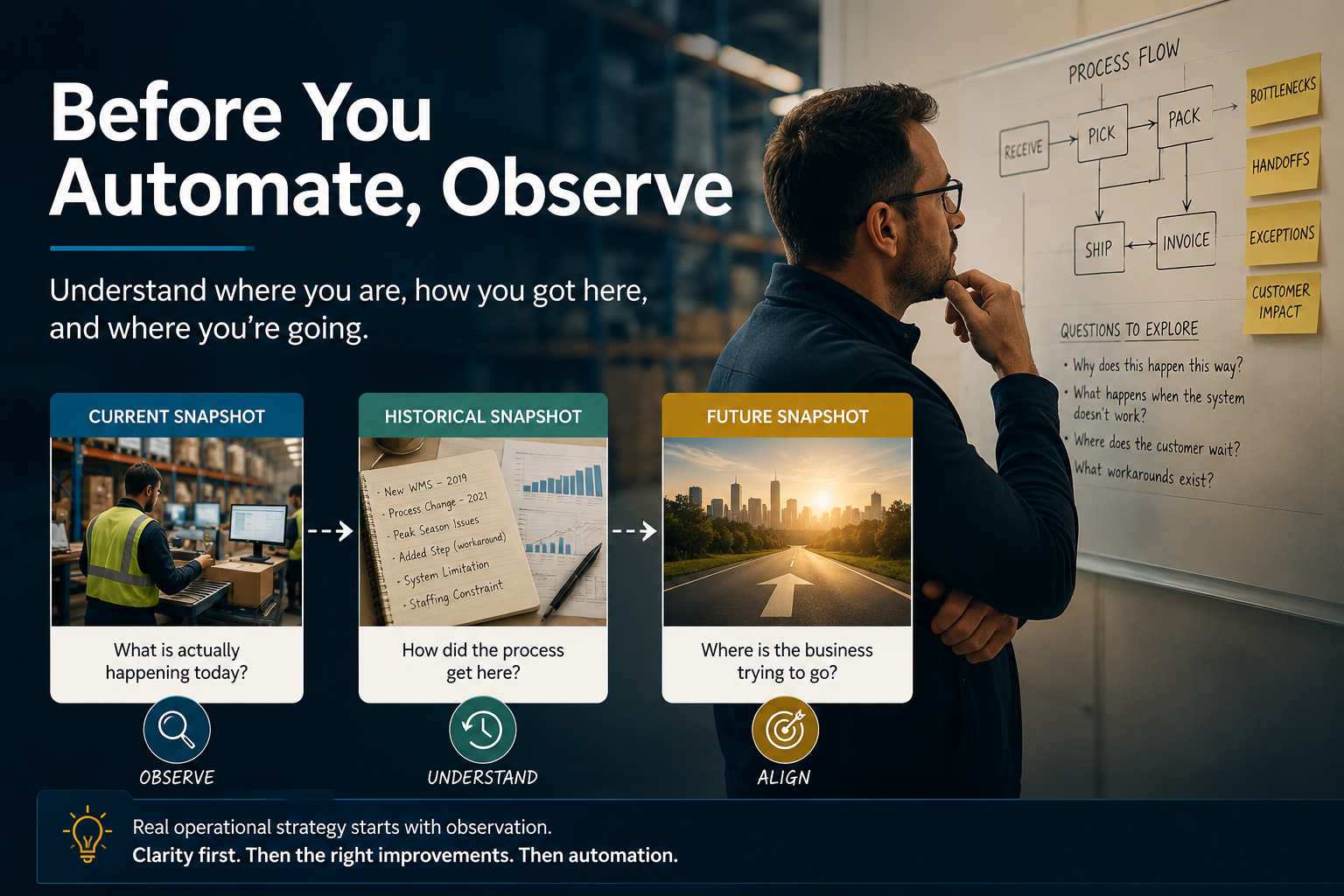
If you want to understand what is really causing that motion, you have to freeze-frame the current situation. You need a snapshot.
But one snapshot is not enough. To really understand a business, you need three views:
- The current snapshot: what is actually happening today.
- The historical snapshot: how the process got here, what has changed, what has been tried, and what people have experienced.
- The future snapshot: where leadership wants the business to go.
That is where real operational strategy begins.
The Current State Is Not Just What the Process Says
Most companies have some version of a process. It might be documented in a system. It might live in a training guide. It might exist in someone's head. In many small and mid-sized businesses, it is often a mix of all three.
But the documented process and the real process are rarely the same thing.
That is why understanding current state requires more than asking, "How does this work?" You have to see it. You have to visit the process, watch the handoffs, review the documentation, observe the exceptions, and listen to the people doing the work — not from a place of judgment, but from a place of curiosity.
This is usually the part where I ask a lot of questions:
- Why does this happen this way?
- Who owns this step?
- What happens when the system does not work?
- Where does the customer wait?
- What does the team do when the process breaks?
- Which part of this is documented, and which part is tribal knowledge?
The answers are almost always more valuable than the original process map.
The documented process and the real process are rarely the same thing.
History Matters Because Every Process Has a Story
To understand a process, you also have to understand its history. A broken process is rarely broken for no reason. It may have been built around an old system, an old customer requirement, a staffing constraint, a workaround, or a leadership decision that made sense at the time.
That means you have to talk to the people who experienced it. But you also have to be careful.
Everyone's perspective is unique. The frontline team sees one version of the problem. Managers see another. Finance sees another. Leadership sees another. Customers see another.
The goal is not to decide who is right immediately. The goal is to collect multiple points of view without judgment so the organization can see the full picture.
That is where many improvement efforts fall short. Companies often jump straight to the solution before they truly understand the story.
The Future State Has to Come From Leadership
Once you understand where the business is and how it got there, you have to understand where it is going. That conversation belongs with leadership.
- What are your goals?
- What are you trying to become?
- What do you value, and what is your mission?
- What is the tangible target?
- Are you trying to increase revenue, improve margin, reduce labor dependency, improve customer experience, scale locations, prepare for acquisition, or simply get control of the day-to-day?
The future state matters because not every operational issue deserves the same level of investment. A process that works 60% of the time may still be good enough for where the business is today. But if that same process blocks growth, hurts the customer experience, or creates hidden cost every week, then it becomes strategic.
That is the part many businesses miss. Operational problems do not always look strategic at first. But over time, they decide what the business can and cannot become.
The Trap of the Cookie-Cutter Solution
After years working in distribution centers, I have seen this play out many times.
One example that always stood out to me was the implementation of robotic stretch wrappers. On paper, it made perfect sense — automate the wrapping process, reduce manual work, improve consistency, increase throughput.
During implementation, there were engineers involved, IT teams integrating systems, operations leaders supervising, and associates testing the process. It looked like progress.
But after implementation, the responsibility for observing and managing the process shifted almost entirely to the floor. Machines were frequently down. At times, a large portion of the fleet was out of commission. Everyone interacting with the equipment could see the solution was not delivering what had been promised.
But the reports still looked good. The project team could still present usage. The charts could still show activity. The implementation could still be described as a success.
Then later that same week, leadership would sit with finance and try to understand why the supposed benefit was not showing up on the P&L.
Activity is not impact. Technology usage is not business value. Automation is not improvement if the operation has to build new workarounds to support it.
The Same Problem Happens in Service Businesses
This is not just a distribution center issue. I have seen similar examples in clinics and service businesses.
A clinic gives patients a tablet to complete intake forms. The idea makes sense — digitize the paperwork, save the front desk time, improve accuracy.
But then the tablet does not work. The patient gets frustrated. The front desk gets pulled back into the process. Someone has to troubleshoot. Someone has to calm down the patient. Someone has to re-enter or correct the information.
At that point, the question becomes simple: what was the purpose of the tool? And even more importantly — what was the purpose of the front desk role if the technology was not designed around the real patient experience?
Again, the issue is not the tablet. The issue is the lack of observation before, during, and after implementation.
Improvement Requires Capacity
The toughest part for any organization trying to follow this kind of framework is not understanding the idea. Most leaders already know they have waste. They know there are broken processes. They know their teams are stretched. They know some systems are not delivering.
The hard part is creating the capacity to actually capture the information, audit the process, build the improvement plan, and hold the organization accountable to that plan.
Day-to-day management takes priority. And in many cases, it should — customers still need to be served, orders still need to ship, patients still need to be seen, and employees still need support.
But if the business never creates time to observe and improve, the same issues keep recycling through the organization. That is how companies end up spending money on solutions that do not solve the real problem.
Strategy Has to Touch the Floor
For C-suite leaders and business owners, this is the practical takeaway:
Your strategy cannot live only in a conference room. It has to touch the floor, the front desk, the warehouse aisle, the service counter, the customer handoff, the system screen, and the employee workaround. That is where the truth of the business lives.
Whether you are a field expert starting a new business, an owner trying to scale, or an executive looking to optimize your team, the path is the same:
- Observe the current state.
- Understand the history.
- Define the future.
Then build the improvement plan around what the business actually needs — not what a cookie-cutter solution promises.
At Strategy67, this is where our framework scales with your business. We help leaders connect operational reality to strategic direction, so improvement is not just another initiative. It becomes part of how the business grows.